Wearable User Research
Wearable
Healthcare
Startups
First-time user experience research for a health-tracking smart earrings.

Impact
Drove Design Directions
Drove Design Directions
9 out of 10 redesign recommendations were implemented directly into the product. By validating design choices early, the research is expected to save the team approximately two months of development work.
9 out of 10 redesign recommendations were implemented directly into the product. By validating design choices early, the research is expected to save the team approximately two months of development work.
Improved Research Practice
Improved Research Practice
Established a repeatable UX research framework that has since been adopted by 3+ other projects, with an estimated 20% reduction in research time for future studies.
Established a repeatable UX research framework that has since been adopted by 3+ other projects, with an estimated 20% reduction in research time for future studies.
Shaped Go-To-Market Strategy
Shaped Go-To-Market Strategy
Findings built a shared understanding of user needs across the team, directly informing decisions around pricing, marketing positioning, and product roadmap priorities.
Findings built a shared understanding of user needs across the team, directly informing decisions around pricing, marketing positioning, and product roadmap priorities.
Skills
Longitudinal Research, In-depth Interviews, Diary Studies, Go-To-Market Strategy, Early Concept, B2C
Role
Solo UXR
Team
The Ubiquitous Computing Lab @ The University of Washington
Timeline
April - August, 2024
PPG (photoplethysmography) earrings are a new type of health-tracking wearable developed at the University of Washington; they are lightweight earrings that monitor health data more accurately than many traditional devices. Backed by funding and a provisional patent, the product has strong commercial potential. But one key question remained: would users actually want to wear them?
I led end-to-end UX research to evaluate the product concept and guide design direction of the PPG earrings. Full paper on this product has been published and presented in CHI 2025.
Impact
Drove Design Directions
9 out of 10 redesign recommendations were implemented directly into the product. By validating design choices early, the research is expected to save the team approximately two months of development work.
Improved Research Practice
Established a repeatable UX research framework that has since been adopted by 3+ other projects, with an estimated 20% reduction in research time for future studies.
Shaped Go-To-Market Strategy
Findings built a shared understanding of user needs across the team, directly informing decisions around pricing, marketing positioning, and product roadmap priorities.
Details
Project Overview
UW researchers developed a health-tracking smart earring to address a gap in the wearable market — a lightweight, accurate alternative to bulky devices like Apple Watch and Fitbit. The product already had strong technical validation: better accuracy than Apple Watch, a provisional patent, published in the Proceedings of the ACM IMWUT, and a $10K CoMotion customer discovery award.
But engineering a working prototype is only half the battle. Would users actually want to wear them? What design features matter most? That's where research came in.
Research Goal
To identify key user needs and design improvements to make PPG earrings something people actually want to wear every day.
My Role
I was the solo UXR working alongside a small team of engineers. I owned everything from scoping and research planning to stakeholder engagement, insight communication, and budget management.
Approach
Because the product was in constant evolution, I designed a multi-phase research framework so insights could drive iterative improvements at each stage.

Phase 1 - Exploratory
Phase 1 Research Question:
Understand the current customer experience with wearables devices:
What do users like and dislike about current health-tracking wearables?
What are their preferences and requirements for earring-form wearables?
What would it take for users to adopt smart earrings for everyday health tracking?
Phase 1 Method - Semi-Structured Interview
To understand real user needs, I conducted 13 semi-structured interviews with earring wearers who had experience with health-tracking devices.
Recruiting on a tight budget ($20/per session) was a challenge. I turned to Facebook, but quickly discovered most responses were scammers. I added photo verification to filter them out, and ended up with 13 genuine, diverse participants across age, gender, industry, and location in the US.
I continued interviewing until I reached data saturation.

Phase 1 Key Insights
As an impact-driven researcher, I made sure to translate findings directly into design or product directions for the next iteration of the PPG earring prototype.
Insight 1: Users will not adopt an earring wearable that feels uncomfortable or looks out of place.
12 out of 13 participants preferred lightweight, small earrings for daily wear. 6 emphasized that comfort level is the single biggest factor in whether they wear earrings regularly. Existing wearables like Fitbit and Apple Watch had already lost users due to discomfort.
"The lighter the better. If it's a stud, I'd want it the size of a fingernail." — P6, Female, 35-44
Call For: Enhanced Comfort
Call For: Enhanced Comfort
Comfort is what determines whether a wearable gets worn or abandoned. For PPG earrings to win over users, it has to feel as natural as a regular earring. So I recommended to:
Make comfort the primary evaluation focus in Phase 2
Test hypoallergenic materials to minimize the risk of skin irritation
Comfort is what determines whether a wearable gets worn or abandoned. For PPG earrings to win over users, it has to feel as natural as a regular earring. So I recommended to:
Make comfort the primary evaluation focus in Phase 2
Test hypoallergenic materials to minimize the risk of skin irritation
Insight 2: Users want health-tracking wearables that look good, connect to their phone, and give them accurate data.
Users didn't just want a device that worked. They wanted one that fit their lifestyle and existing habits.
Good design, smartphone integration, and data accuracy were the three features users consistently valued most. Discomfort and inaccurate data were the top two reasons users abandoned existing devices.
"With the Oura ring, I feel like it looks like an accessory, not a tracking device. It's supposed to be more stylish." — P5, Female, 25-34
Call For: Frictionless Everyday Wear
Call For: Frictionless Everyday Wear
These were signals about what makes a wearable sticky. So I recommended to:
Collaborate with a jewelry designer to make the earring customizable and outfit-friendly
Add smartphone integration so users could view health data without disrupting their routine
Validate data accuracy through a parallel engineering project, and use the results as a credible foundation for future marketing claims
These were signals about what makes a wearable sticky. So I recommended to:
Collaborate with a jewelry designer to make the earring customizable and outfit-friendly
Add smartphone integration so users could view health data without disrupting their routine
Validate data accuracy through a parallel engineering project, and use the results as a credible foundation for future marketing claims
Working with a jewelry designer, we replaced the fixed flower design with a more classic, customizable look. This allows users to swap out decorative modules to match different outfits and occasions.
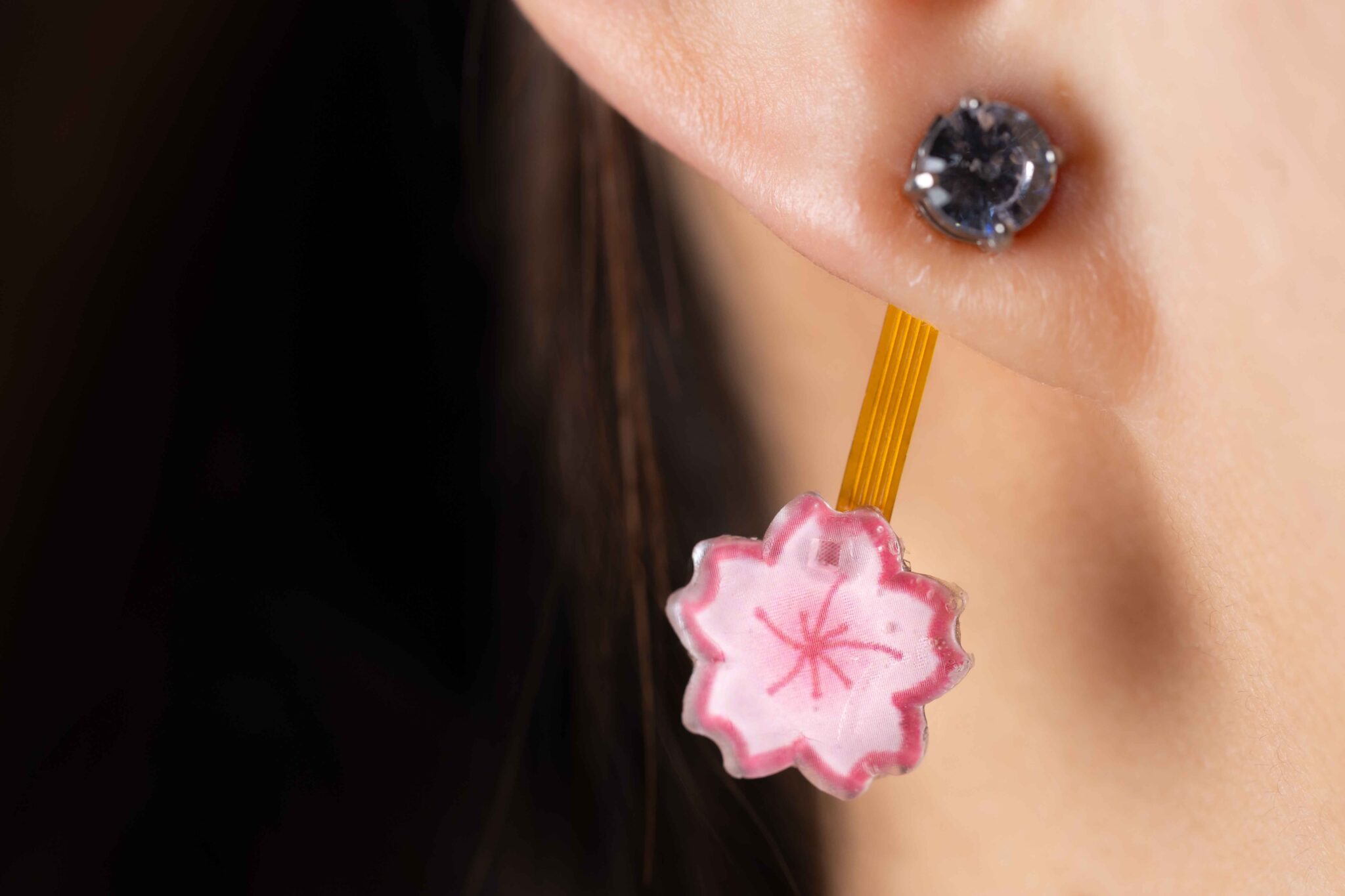
Previous Design: Fixed design that may not match outfit.
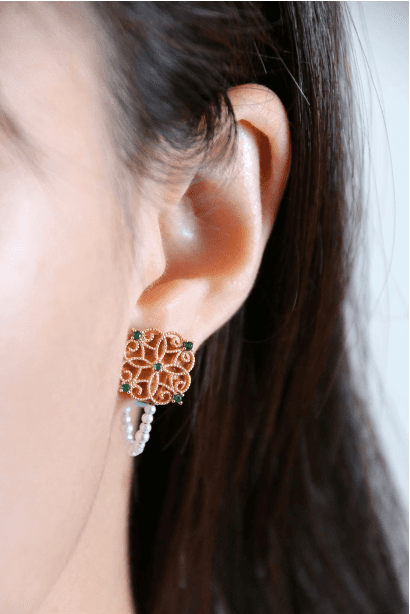
Current Design: Customizable. Adaptable to any occasion.
Insight 3: Most users were open to smart earrings, but we needed hard evidence to turn interest into confidence.
85% of participants were willing to wear smart earrings daily, and many already thought smart earrings could be more comfortable and convenient than existing devices.
What would actually win them over was proof that smart earrings outperform current wearables in terms of comfort, convenience, and data accuracy.
"I prefer earrings over rings because I don't even need to think about it." — P9, Female, 25-34
Call For: Prove It in the Real World
Call For: Prove It in the Real World
Recommendations:
Conduct a head-to-head comfort and usability evaluation against a mainstream wearable device in Phase 2
Use a standardized Comfort Rating Scale to enable rigorous benchmarking across devices
Use the results to inform how we position PPG earrings against competitors in go-to-market strategy
Recommendations:
Conduct a head-to-head comfort and usability evaluation against a mainstream wearable device in Phase 2
Use a standardized Comfort Rating Scale to enable rigorous benchmarking across devices
Use the results to inform how we position PPG earrings against competitors in go-to-market strategy
Transition Into Phase 2 - Evaluative
Phase 1 reshaped both the product and the research agenda. The insights didn't just inform redesign decisions, but also shaped what we needed to evaluate next. Going into Phase 2, the core question was: does the redesigned prototype actually deliver on what users said they needed?
Phase 2 Research Question:
In what contexts and activities do users wear the PPG earrings throughout their day?
How easy is it to set up and use the PPG earrings in real life?
How does the comfort of prolonged wear compare to Fitbit?
Phase 2 Methods - Diary Study
Phase 1 told us what users needed. Phase 2 was about putting the redesigned prototype in front of real users and seeing how it held up in the real world. Usability testing was the obvious choice, but it wasn't the best one here. Earrings are worn for hours at a time, and a lab session couldn't capture how the device felt across a full day of real activities. So I proposed a diary study instead.
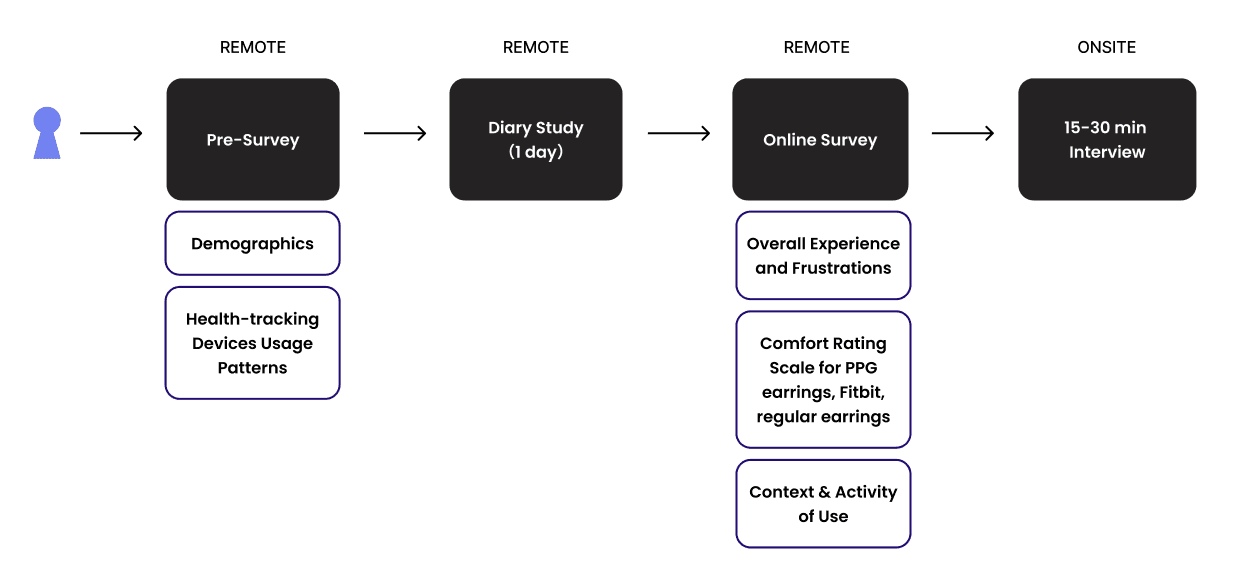
6 participants wore both the PPG earrings and a Fitbit throughout their daily routines for one day, logging activities in the Earring App. At the end of the day, they completed a survey and a short in-person interview
To enable rigorous benchmarking across devices, I used the standardized Comfort Rating Scale to assess comfort levels across different devices.
Phase 2 Key Findings
Insight 1: PPG earrings were as comfortable as wearing a regular earring.
All 6 participants rated the PPG earrings as highly comfortable, with an average Likert rating of 1.33 out of 7 (where 1 = very comfortable).
All participants said it felt no different from a regular earring.
5 out of 6 were willing to wear them for 12 or more hours. (The sixth preferred 7 hours due to skin sensitivity.)
"It was just as comfortable. I often forgot I had it on."
What This Means
Comfort was the make-or-break requirement from Phase 1, and the redesigned prototype passed. This is strong evidence that the product can meet the daily wear standard users set in Phase 1.
Recommendations & Next Steps
Recommendations & Next Steps
Use these results as a credible foundation for go-to-market messaging around comfort
Explore hypoallergenic materials like gold to address skin sensitivity for the remaining edge cases
Use these results as a credible foundation for go-to-market messaging around comfort
Explore hypoallergenic materials like gold to address skin sensitivity for the remaining edge cases
Insight 2: PPG earrings were consistently rated more comfortable than Fitbit across every comfort dimension.
Using the Comfort Rating Scale, PPG earrings outperformed Fitbit across all six comfort descriptors. The biggest win was in the "attachment" category: users were less aware of the earring on their body compared to the Fitbit. For a wearable that needs to be worn all day, this is a promising signal.
"I didn't like how bulky watches are. They inhibit some movement."
What This Means
Users came into Phase 1 skeptical that earrings could outperform existing wearables. Phase 2 gave us the data to back that up.
Recommendations & Next Steps
Recommendations & Next Steps
Use the side-by-side Comfort Rating Scale results as a concrete, evidence-based differentiator in marketing and product positioning
Continue testing across more activities and user profiles to strengthen the evidence base before launch
Use the side-by-side Comfort Rating Scale results as a concrete, evidence-based differentiator in marketing and product positioning
Continue testing across more activities and user profiles to strengthen the evidence base before launch

Overall, PPG earring consistently scored lower (indicating more comfort) across all descriptors.
Notably, PPG earring received significantly lower scores in the "attachment" category (awareness of device presence/movement), with participants reporting they were less aware of the earring compared to the Fitbit.
Reflection
What I learned:
Make it exist first, then make it better
Make it exist first, then make it better
Early in this project, I spent too much time trying to design the perfect study before starting. What moved things forward was shipping a version, learning from it, and refining, as speed matters in getting your insights drive real decisions.
Early in this project, I spent too much time trying to design the perfect study before starting. What moved things forward was shipping a version, learning from it, and refining, as speed matters in getting your insights drive real decisions.
Be adaptable
Be adaptable
While methods like usability testing worked in past studies, they weren’t the best fit for this project. It’s important to stay focused on the research goal, context, stakeholder requirements and choose methods accordingly, rather than relying on what worked before.
While methods like usability testing worked in past studies, they weren’t the best fit for this project. It’s important to stay focused on the research goal, context, stakeholder requirements and choose methods accordingly, rather than relying on what worked before.
What I would do differently:
Research Methods
Research Methods
If I were to have more time and resources, I would extend the diary study to 7 days (1 day in this study due to a tight timeline). I would also check in with participants throughout the 7-day study to ensure they are following instructions and fully understand expectations.
If I were to have more time and resources, I would extend the diary study to 7 days (1 day in this study due to a tight timeline). I would also check in with participants throughout the 7-day study to ensure they are following instructions and fully understand expectations.
Recruitment & Scheduling
Recruitment & Scheduling
I would over-recruit and schedule more participants than needed, so that the research process would not have been delayed by no-shows.
I would over-recruit and schedule more participants than needed, so that the research process would not have been delayed by no-shows.
See also
More Projects

Usability Study: Amazon’s Comparison Chart
E-Commerce
A usability study uncovering what prevents customers from making confident purchase decisions with Amazon's comparison chart, and how to fix it.

AI-Augmented Research: Turning Longitudinal Survey Data into Actionable Insight
FinTech
Web3
Built an custom AI agent to analyze thousands of survey responses at high accuracy, uncovering growing user pain points that guided product priorities. [Password protected due to NDA. Please reach out for access.]
Usability Study: Amazon’s Comparison Chart
E-Commerce
A usability study uncovering what prevents customers from making confident purchase decisions with Amazon's comparison chart, and how to fix it.
AI-Augmented Research: Turning Longitudinal Survey Data into Actionable Insight
FinTech
Web3
Built an custom AI agent to analyze thousands of survey responses at high accuracy, uncovering growing user pain points that guided product priorities. [Password protected due to NDA. Please reach out for access.]
Wearable User Research
Wearable
Healthcare
First-time user experience research for a health-tracking smart earrings.
Tags
Longitudinal Research, In-depth Interviews, Diary Studies, Go-to-market Strategy, Early Concept, B2C
Role
Solo UXR
Team
The Ubiquitous Computing Lab @ The University of Washington
Timeline
6 weeks
PPG (photoplethysmography) earrings are a new type of health-tracking wearable developed at the University of Washington; they are lightweight earrings that monitor health data more accurately than many traditional devices. Backed by funding and a provisional patent, the product has strong commercial potential. But one key question remained: would users actually want to wear them?
I led end-to-end UX research to evaluate the product concept and guide design direction of the PPG earrings.
Note: full paper of this research has been published and presented in CHI 2025.
Impact
Drove Design Directions: 9 out of 10 redesign recommendations were implemented directly into the product. By validating design choices early, the research is expected to save the team approximately two months of development work.
Improved Research Practice: Established a repeatable UX research framework that has since been adopted by 3+ other projects, with an estimated 20% reduction in research time for future studies.
Shaped Go-To-Market Strategy: Findings built a shared understanding of user needs across the team, directly informing decisions around pricing, marketing positioning, and product roadmap priorities.
Phase 1 - Exploratory
Phase 1 Research Question:
Understand the current customer experience with wearables devices
What do users like and dislike about current health-tracking wearables?
What are their preferences and requirements for earring-form wearables?
What would it take for users to adopt smart earrings for everyday health tracking?
Phase 1 Method - Semi-Structured Interview
To understand real user needs, I conducted 13 semi-structured interviews with earring wearers who had experience with health-tracking devices.
Recruiting on a tight budget ($20/per session) was a challenge. I turned to Facebook, but quickly discovered most responses were scammers. I added photo verification to filter them out, and ended up with 13 genuine, diverse participants across age, gender, industry, and location in the US.
I continued interviewing until I reached data saturation.
Phase 1 Key Insights
As an impact-driven researcher, I made sure to translate findings directly into design or product directions for the next iteration of the PPG earring prototype.
Insight 1: Users will not adopt an earring wearable that feels uncomfortable or looks out of place.
12 out of 13 participants preferred lightweight, small earrings for daily wear. 6 emphasized that comfort level is the single biggest factor in whether they wear earrings regularly. Existing wearables like Fitbit and Apple Watch had already lost users due to discomfort.
"The lighter the better. If it's a stud, I'd want it the size of a fingernail." — P6, Female, 35-44
Call For: Enhanced Comfort
Comfort is what determines whether a wearable gets worn or abandoned. For PPG earrings to win over users, it has to feel as natural as a regular earring. So I recommended to:
Make comfort the primary evaluation focus in Phase 2
Test hypoallergenic materials to minimize the risk of skin irritation
Insight 2: Users want health-tracking wearables that look good, connect to their phone, and give them accurate data.
Users didn't just want a device that worked. They wanted one that fit their lifestyle and existing habits.
Good design, smartphone integration, and data accuracy were the three features users consistently valued most. Discomfort and inaccurate data were the top two reasons users abandoned existing devices.
"With the Oura ring, I feel like it looks like an accessory, not a tracking device. It's supposed to be more stylish." — P5, Female, 25-34
Call For: Frictionless Everyday Wear
These were signals about what makes a wearable sticky. So I recommended to:
Collaborate with a jewelry designer to make the earring customizable and outfit-friendly
Add smartphone integration so users could view health data without disrupting their routine
Validate data accuracy through a parallel engineering project, and use the results as a credible foundation for future marketing claims
Working with a jewelry designer, we replaced the fixed flower design with a more classic, customizable look. This allows users to swap out decorative modules to match different outfits and occasions.
Previous Design: Fixed design that may not match outfit.
Current Design: Customizable. Adaptable to any occasion.
Insight 3: Most users were open to smart earrings, but we needed hard evidence to turn interest into confidence.
85% of participants were willing to wear smart earrings daily, and many already suspected they could be more comfortable and convenient than existing devices.
What would actually win them over was proof that smart earrings outperform current wearables in comfort, convenience, and data accuracy.
"I prefer earrings over rings because I don't even need to think about it." — P9, Female, 25-34
Call For: Prove It in the Real World
Recommendations:
Conduct a head-to-head comfort and usability evaluation against a mainstream wearable device in Phase 2
Use a standardized Comfort Rating Scale to enable rigorous benchmarking across devices
Use the results to inform how we position PPG earrings against competitors in go-to-market strategy
Transition Into Phase 2 - Evaluative
Phase 1 reshaped both the product and the research agenda. The insights didn't just inform redesign decisions, but also shaped what we needed to evaluate next. Going into Phase 2, the core question was: does the redesigned prototype actually deliver on what users said they needed?
Phase 2 Research Question:
In what contexts and activities do users wear the PPG earrings throughout their day?
How easy is it to set up and use the PPG earrings in real life?
How does the comfort of prolonged wear compare to Fitbit?
Phase 2 Methods - Diary Study
Phase 1 told us what users needed. Phase 2 was about putting the redesigned prototype in front of real users and seeing how it held up in the real world. Usability testing was the obvious choice, but it wasn't the best one here. Earrings are worn for hours at a time, and a lab session couldn't capture how the device felt across a full day of real activities. So I proposed a diary study instead.
6 participants wore both the PPG earrings and a Fitbit throughout their daily routines for one day, logging activities in the Earring App. At the end of the day, they completed a survey and a short in-person interview
To enable rigorous benchmarking across devices, I used the standardized Comfort Rating Scale to assess comfort levels across different devices.
Phase 2 Key Findings
Insight 1: PPG earrings were as comfortable as wearing a regular earring.
All 6 participants rated the PPG earrings as highly comfortable, with an average Likert rating of 1.33 out of 7 (where 1 = very comfortable).
All participants said it felt no different from a regular earring.
5 out of 6 were willing to wear them for 12 or more hours. (The sixth preferred 7 hours due to skin sensitivity.)
"It was just as comfortable. I often forgot I had it on."
What This Means
Comfort was the make-or-break requirement from Phase 1, and the redesigned prototype passed. This is strong evidence that the product can meet the daily wear standard users set in Phase 1.
Recommendations & Next Steps
Use these results as a credible foundation for go-to-market messaging around comfort
Explore hypoallergenic materials like gold to address skin sensitivity for the remaining edge cases
Insight 2: PPG earrings were consistently rated more comfortable than Fitbit across every comfort dimension.
Using the Comfort Rating Scale, PPG earrings outperformed Fitbit across all six comfort descriptors. The biggest win was in the "attachment" category: users were less aware of the earring on their body compared to the Fitbit. For a wearable that needs to be worn all day, this is a promising signal.
"I didn't like how bulky watches are. They inhibit some movement."
What This Means
Users came into Phase 1 skeptical that earrings could outperform existing wearables. Phase 2 gave us the data to back that up.
Recommendations & Next Steps
Use the side-by-side Comfort Rating Scale results as a concrete, evidence-based differentiator in marketing and product positioning
Continue testing across more activities and user profiles to strengthen the evidence base before launch
Overall, PPG earring consistently scored lower (indicating more comfort) across all descriptors.
Notably, PPG earring received significantly lower scores in the "attachment" category (awareness of device presence/movement), with participants reporting they were less aware of the earring compared to the Fitbit.
Reflection
Key Learnings:
Make it exist first, then make it better
Early in this project, I spent too much time trying to design the perfect study before starting. What moved things forward was shipping a version, learning from it, and refining, as speed matters in getting your insights drive real decisions.
Be adaptable
While methods like usability testing worked in past studies, they weren’t the best fit for this project. It’s essential to stay focused on the research goal, context, stakeholder requirements and choose methods accordingly, rather than relying on what worked before.
What I would do differently?
Research Methods
If I were to have more time, budget, and resources, I would extend the diary study to 7 days for richer insights. I would also check in with participants throughout the 7-day study to ensure they are following instructions and fully understand expectations.
Recruitment & Scheduling
I would over-recruit and schedule more participants than needed, so that the research process would not have been delayed by no-shows.
Details
See also
More Projects
See also
More Projects
Usability Study: Amazon’s Comparison Chart
E-Commerce
A usability study uncovering what prevents customers from making confident purchase decisions with Amazon's comparison chart, and how to fix it.
AI-Augmented Research: Turning Longitudinal Survey Data into Actionable Insight
FinTech
Web3
Built an custom AI agent to analyze thousands of survey responses at high accuracy, uncovering growing user pain points that guided product priorities. [Password protected due to NDA. Please reach out for access.]